Using a Trust to Keep a Parent's Home Out of NC Probate

What Happened
A North Carolina estate planning law firm published a detailed Q&A examining one of the most common questions adult children ask when aging parents own real estate: how does a revocable living trust prevent a family home from passing through probate? The article, published in October 2026, walks through the legal mechanics of transferring a parent's home into a trust, the role of deed recording, and the pitfalls that leave many families exposed even after a trust document is signed.
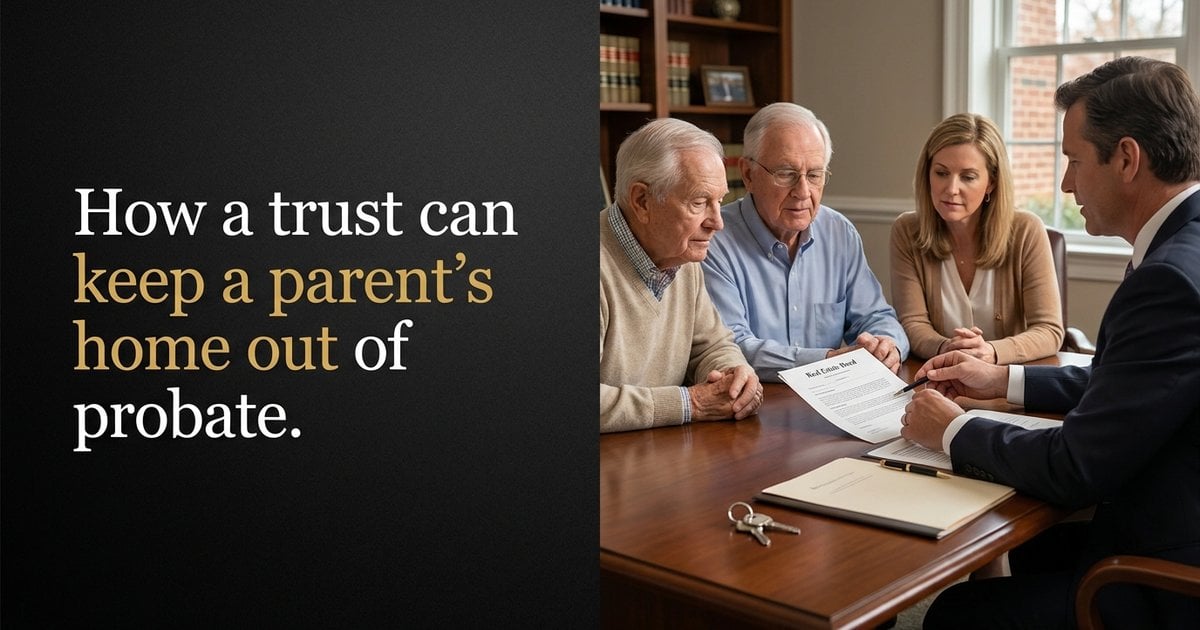
The analysis centers on a scenario familiar to many North Carolina families. An elderly parent holds title to a home that was once jointly owned with a now-deceased spouse. The parent wants an adult child to receive or manage the property after death, without the delays and costs of a probate transfer. The article explains that a revocable living trust solves this problem only when two conditions are met: the trust document is properly executed, and a deed conveying the home to the trustee is signed, delivered, and recorded with the county Register of Deeds before the parent dies.
The article also addresses a critical preliminary step that families often overlook. Before any trust deed is signed, the original deed must be examined to determine how the spouses held title. If they held the property as tenants by the entirety, the surviving parent became the sole owner automatically when the spouse died, and no additional estate proceedings are necessary. If the spouses held separate shares, the deceased spouse's interest may require its own legal resolution before the parent can transfer the full property into a trust. The article emphasizes that the deceased spouse's name appearing on an old deed does not, by itself, answer this question.
What It Means
For North Carolina families, the stakes around probate are significant. North Carolina does not offer independent administration, meaning executors operate under ongoing court supervision throughout the estate settlement process. The typical probate timeline runs 9 months to 12 months, and attorney fees typically range from 2%N.C.G.S. § 28A-13-3(a)(19), § 28A-23-3(a) (attorney fees are a negotiated administration expense; no statutory schedule or percentage)Verified Sep 8, 2026View source to 3.1%N.C.G.S. § 28A-13-3(a)(19), § 28A-23-3(a) (attorney fees are a negotiated administration expense; no statutory schedule or percentage)Verified Sep 8, 2026View source of the estate. A family home is often the largest asset in an estate, meaning even a modestly valued property can generate thousands of dollars in probate costs. North Carolina also requires a surety bond for executors, though the will can waive this requirement, adding another layer of cost and complexity. The Probate Cost Calculator provides a free, state-specific estimate of what probate may cost for a North Carolina estate.
The article's core legal point carries practical weight for families acting as caregivers or financial managers for aging parents. A trust document alone does not transfer real estate. North Carolina recording law protects lien creditors and purchasers for value who act before a deed is recorded. An unrecorded deed, or a trust that merely lists a home on a schedule without a corresponding deed, leaves the property in the parent's individual name at death. That means the home passes through the will — and the will must go through probate to transfer title. A pour-over will can direct omitted assets into the trust, but the will itself still requires probate first. The article's warning about unfunded trusts reflects a pattern that repeats across estates of every size: families discover too late that the trust they believed protected the home never actually held it. The guide to avoiding probate with a trust explains why funding is the step that makes the difference.
The article also addresses an alternative that families sometimes pursue: adding an adult child directly to the deed as a co-owner. This approach creates immediate co-ownership rather than a future transfer. The parent loses the ability to sell, refinance, or revise the arrangement without the child's cooperation. The child's creditors, divorce proceedings, or other legal claims can reach the property while the parent is still alive. A revocable trust avoids these consequences by keeping full control with the parent during their lifetime. The parent typically serves as both the initial trustee and the beneficiary of their own trust, retaining the right to live in, sell, or refinance the home. The successor trustee's authority activates only after the parent's incapacity or death. North Carolina also recognizes that any power of attorney intended to allow an agent to create, amend, fund, or manage a trust must contain express authority for those specific actions — a detail that matters when a parent's capacity becomes uncertain before the trust is fully funded. North Carolina does not currently authorize transfer-on-death deeds for real estate, making a properly funded revocable trust the primary tool for keeping a home out of probate. Families navigating these decisions can also review the seven reasons for bypassing probate for a broader view of what probate avoidance accomplishes.
Context from SimplyTrust
The scenario described in this article — a parent's home, a deceased spouse's name on the deed, and an adult child waiting to help — reflects one of the most common estate planning situations in North Carolina. The decision to use a revocable trust rather than a direct deed transfer preserves the parent's control while creating a clear path for the successor trustee to act without court involvement. North Carolina does not impose a state estate or inheritance tax, so the primary financial concern for most families is the cost and delay of probate rather than tax exposure. The federal estate tax exemption currently stands at $15,000,00026 USC 2001(c), 2010; P.L. 119-21 §70106Verified Sep 15, 2026View source per individual, placing most North Carolina family homes well below the federal threshold. For families focused on keeping a home transfer simple, private, and out of court, a funded revocable trust remains the most direct path available under current North Carolina law.
SimplyTrust's revocable living trust platform allows individuals to create, fund, and update a trust from their phone. The platform includes personalized funding instructions for real estate, bank accounts, and other assets, addressing the gap that the article identifies as the most common point of failure: signing a trust without completing the deed transfer. Families who want to understand the full scope of settling an estate — including the steps a successor trustee takes after a parent's death — can use the free Estate Settlement Checklist to map out the process before it becomes urgent.
Source: How can a trust help keep a parent's home out of probate? NC