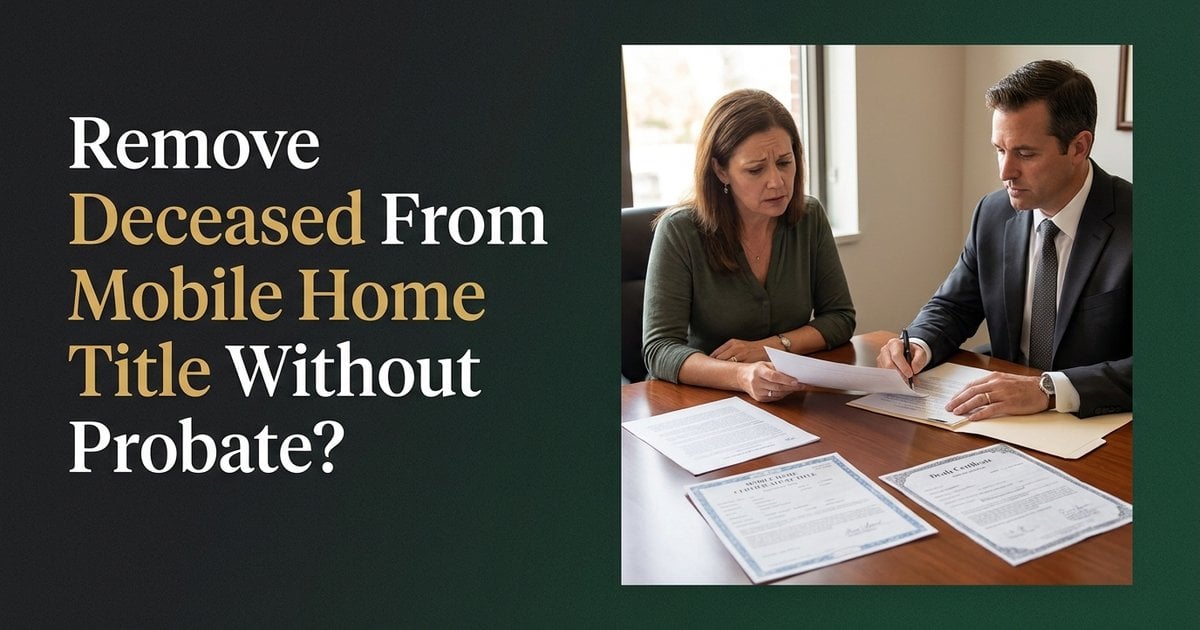
NC Mobile Home Title Transfer Without Probate

What Happened
A North Carolina estate planning law firm recently addressed a common but complicated question: can a deceased person's name be removed from a mobile home title when no probate estate was ever opened? The answer, according to North Carolina law, is yes — but the path forward depends heavily on how the title was held and whether the original owners had survivorship rights.
The scenario involves a mobile home with two co-owners, one of whom has died, where an attempted lifetime transfer may have been incomplete. The surviving party or the heirs of the deceased co-owner face a title that still carries a dead person's name. In North Carolina, mobile homes with active DMV certificates of title follow vehicle transfer rules, not real estate rules — which creates a distinct legal process that many families do not expect.
The firm's analysis walks through the controlling statutes, the role of the North Carolina Division of Motor Vehicles, and the specific affidavit procedure — known as Form MVR-317 — that allows heirs to transfer a deceased owner's interest without opening a full probate estate. The article also identifies the circumstances under which that simplified procedure fails and a formal estate administration becomes unavoidable.
What It Means
For North Carolina families, this situation touches on one of the most overlooked intersections in estate planning: the gap between vehicle title law and probate law. Mobile homes occupy an unusual legal category. If the DMV title remains active and the home has not been permanently affixed to land and converted to real property, the transfer process runs through the DMV — not the county deed records. That distinction matters enormously when a co-owner dies without a will or without a completed transfer.
North Carolina does offer a small estate affidavit procedure for personal property. The Affidavit for Collection of Personal PropertyN.C.G.S. § 28A-25-1Verified Sep 8, 2026View source allows heirs to collect personal property without full probate when the estate's personal property does not exceed $20,000N.C.G.S. § 28A-25-1Verified Sep 8, 2026View source, or up to $30,000N.C.G.S. § 28A-25-1Verified Sep 8, 2026View source when a surviving spouse is the sole heir. Families must wait 30 daysN.C.G.S. § 28A-25-1Verified Sep 8, 2026View source after the date of death before using this procedure. However, the article makes clear that this general small estate affidavit is legally separate from the DMV's own deceased-owner title affidavit under Form MVR-317. Using the wrong procedure can leave the title in limbo.
The survivorship designation on the DMV title controls the outcome in most cases. North Carolina law treats unmarried co-owners as tenants in common by default, meaning each owner holds a separate, transferable interest. Without express survivorship language on the title, the deceased owner's interest does not pass automatically to the survivor. Instead, all heirs of the deceased owner must sign the MVR-317 affidavit, and the Clerk of Superior Court must certify it before the DMV will issue a corrected title. If any heir cannot be located, refuses to sign, or disputes ownership, the no-administration procedure breaks down entirely. At that point, families face a choice: pursue a limited or full estate administration, or attempt to resolve the heir dispute through other legal channels. North Carolina's probate process typically runs 9 months to 12 months for an average estate, and creditors have 3 monthsN.C.G.S. § 28A-14-1(a), § 28A-19-3Verified Sep 8, 2026View source from the date of the first published notice to file claims. Executors in North Carolina must also obtain a surety bond, though the will can waive this requirement. For a family trying to resolve a mobile home title, these timelines and requirements can feel disproportionate to the asset's value — which is precisely why the MVR-317 affidavit procedure exists as an alternative.
The article also flags a critical complication: if the mobile home was permanently affixed to land and the DMV title was surrendered and canceled, the home converts to real property. At that point, the deed and county land records govern the transfer — not the vehicle title process. Families in this situation need to examine both the DMV records and the county register of deeds before choosing a transfer method. North Carolina does not currently offer a transfer-on-death deed for real property, which means real property held outside a trust or joint tenancy typically passes through probate. That absence makes proactive planning — such as placing real property into a revocable trust — a meaningful way to avoid the problem entirely. Families interested in understanding the full scope of avoiding probate with a trust can find a detailed breakdown of how that strategy works in practice.
One additional complexity the article highlights involves liens. A no-estate title transfer does not erase a creditor's recorded lien on the mobile home. Any existing lien survives the ownership change and remains attached to the property. Families who discover an outstanding lien during the MVR-317 process must address it separately before the DMV will issue a clean title. This is one reason an estate inventory checklist proves valuable early in the process — identifying liabilities attached to specific assets before the transfer attempt saves significant time and prevents surprises at the DMV counter.
North Carolina imposes no state estate or inheritance tax, which means the title transfer itself carries no state death tax consequence regardless of the mobile home's value. At the federal level, the estate tax exemption currently stands at $15,000,00026 USC 2001(c), 2010; P.L. 119-21 §70106Verified Sep 15, 2026View source per individual, placing the vast majority of mobile home estates well below the threshold where federal estate tax becomes relevant. The more pressing financial concern for most families is the cost of any probate proceeding that becomes necessary if the simplified procedure fails. North Carolina attorney fees for probate administration typically run 2%N.C.G.S. § 28A-13-3(a)(19), § 28A-23-3(a) (attorney fees are a negotiated administration expense; no statutory schedule or percentage)Verified Sep 8, 2026View source to 3.1%N.C.G.S. § 28A-13-3(a)(19), § 28A-23-3(a) (attorney fees are a negotiated administration expense; no statutory schedule or percentage)Verified Sep 8, 2026View source of the estate, and court filing fees follow a scaled structure based on the value of personal property in the estate.
Context from SimplyTrust
The mobile home title situation illustrates a broader truth about estate planning: assets that seem simple often carry the most procedural complexity after death. A mobile home, a vehicle, a bank account without a named beneficiary — each of these can create months of administrative work for surviving family members when no plan exists. Understanding what probate actually involves helps families recognize which assets fall into the court-supervised process and which can transfer through simpler channels. The distinction between a titled vehicle, a converted-to-real-property manufactured home, and a trust-held asset determines everything about how smoothly the transfer proceeds.
For North Carolina families navigating an estate where a mobile home or other titled asset appears without a clear transfer mechanism, the Do I Need Probate tool offers a starting point for understanding whether a formal court proceeding is necessary. Families who want a broader picture of what the probate process costs in North Carolina — including court filing fees, attorney fees, and executor compensation — can use the Probate Cost Calculator to estimate those figures based on the estate's size. Planning ahead, whether through a revocable trust, proper title designations, or beneficiary designations on financial accounts, remains the most reliable way to keep a family out of the DMV and the courthouse after a loved one's death.
Source: Can a mobile home be removed from a deceased person's name if no probate estate was opened? NC