Civil Judgments and NC Probate: What Families Face

What Happened
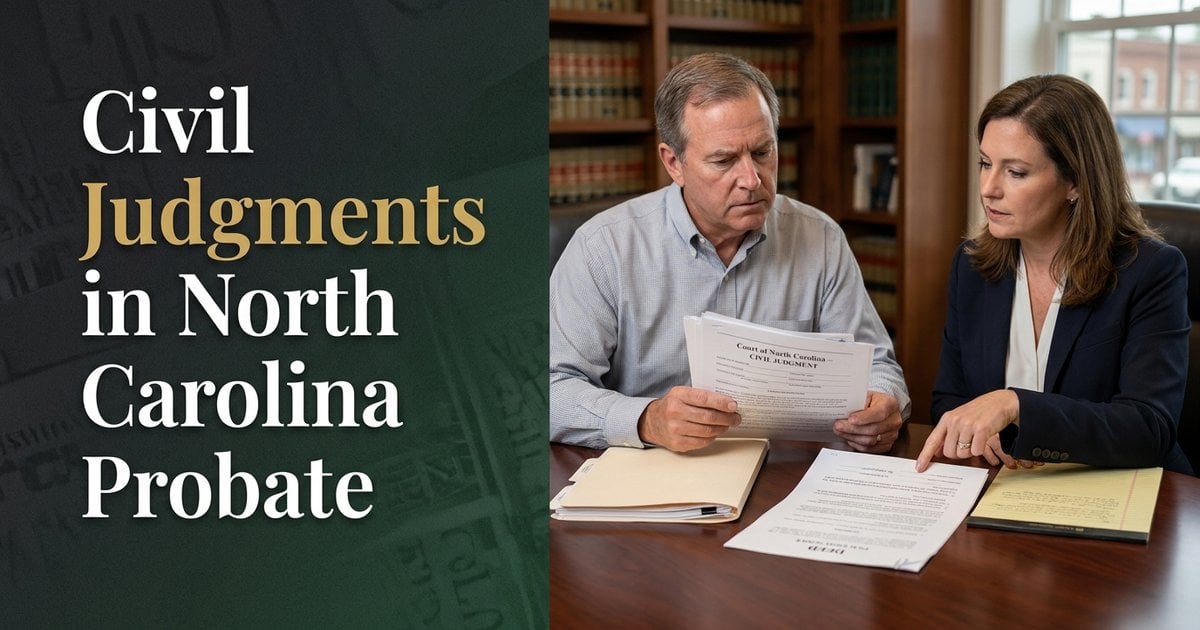
A North Carolina estate law firm published a detailed analysis addressing one of the more overlooked complications in probate administration: what happens when a civil judgment against a deceased person exists at the time of death. The piece, written for families and personal representatives navigating North Carolina estates, clarifies that a valid, unpaid civil judgment entered before death does not simply disappear. It becomes a potential claim against the estate and can reduce what beneficiaries ultimately receive.
The analysis draws an important legal distinction that many families miss. Filing a lawsuit against someone before they die is not the same as holding a judgment against them. A complaint initiates a civil case, but only an entered judgment establishes the court-ordered obligation. For that judgment to attach as a lien on real property, the Clerk of Superior Court must docket and index it in the county where the property sits. That lien generally lasts ten years from the date the judgment was entered. A lawsuit still pending at the time of death requires substitution of the personal representative and further proceedings before it can establish any debt or lien.
The article also walks through the procedural steps a personal representative must take to verify whether a judgment actually affects the estate. That verification process includes confirming the identity of the judgment debtor, the amount still owed, whether the judgment was satisfied or appealed, and whether it was properly docketed in the relevant county. The piece emphasizes that distributing estate assets before completing this review creates serious risk for the personal representative and for beneficiaries who might later face clawback.
What It Means
For North Carolina families managing an estate, this issue surfaces the broader complexity of the state's probate process. North Carolina does not offer independent administration, meaning the Clerk of Superior Court maintains active oversight throughout the proceeding. Every accounting, every creditor determination, and every distribution decision happens under that supervision. That structure gives creditors meaningful opportunities to assert claims, and it places significant responsibility on personal representatives to get the sequencing right.
The creditor claim deadline in North Carolina estates is 3 monthsN.C.G.S. § 28A-14-1(a), § 28A-19-3Verified Sep 8, 2026View source from the first publication of the notice to creditors. A creditor receiving individual notice may have 90 days from the date that notice was mailed or delivered, if that period ends later than the general deadline. Creditors holding existing judgment liens against estate property receive different treatment under state law than unsecured creditors. An action enforcing a judgment lien that attached to real property before death falls outside the ordinary creditor bar in certain circumstances, which means the personal representative cannot simply ignore an old judgment because the claim deadline has passed. The lien may still encumber the property regardless. This distinction matters enormously when the estate includes real property in a county where the judgment was docketed.
North Carolina also requires the personal representative to pay valid claims in statutory priority order rather than on a first-come, first-served basis. That priority structure means a personal representative who distributes assets to beneficiaries before resolving judgment claims risks personal liability. The estate's court filing fee structure scales with the value of personal property in the estate, and attorney fees typically run between 2%N.C.G.S. § 28A-13-3(a)(19), § 28A-23-3(a) (attorney fees are a negotiated administration expense; no statutory schedule or percentage)Verified Sep 8, 2026View source and 3.1%N.C.G.S. § 28A-13-3(a)(19), § 28A-23-3(a) (attorney fees are a negotiated administration expense; no statutory schedule or percentage)Verified Sep 8, 2026View source of the estate's value. Adding unresolved judgment claims to that equation can extend the timeline well beyond the typical 9 months to 12 months that most North Carolina estates require. Families who want to understand the full cost picture before administration begins can use the Probate Cost Calculator to generate state-specific estimates for North Carolina estates. For a broader look at what North Carolina probate involves, the Cost of Probate in North Carolina guide breaks down every fee category in detail.
The judgment lien issue also highlights why real property creates complications that personal property does not. A judgment docketed in Durham County does not automatically attach to real property the decedent owned in Wake County. A transcript of the judgment must be docketed in each county where the property sits for the lien to attach there. Personal representatives administering estates with real property in multiple North Carolina counties must check the judgment docket in each relevant county separately. Skipping that step and distributing real property without clearing potential liens exposes both the personal representative and the recipient to future enforcement actions. For families wondering whether the estate even requires formal probate, the Do I Need Probate? tool helps assess whether simplified procedures might apply based on asset types and estate size.
North Carolina does not currently authorize transfer-on-death deeds for real property, which means real estate typically passes through probate unless held in a trust or through joint tenancy with right of survivorship. That gap in available planning tools makes the judgment lien risk more acute for North Carolina property owners. Real property that passes through probate remains exposed to judgment liens during administration in a way that property held in a properly funded revocable trust is not, because trust assets do not become part of the probate estate. Understanding how a trust avoids probate becomes especially relevant when a decedent held real property and creditors may hold docketed judgments.
Context from SimplyTrust
The judgment lien issue underscores a recurring theme in estate administration: the personal representative role carries real legal exposure, and the sequencing of decisions matters as much as the decisions themselves. Personal representatives in North Carolina must complete an inventory within 90 daysN.C.G.S. §§ 28A-20-1, 28A-20-3, 28A-20-4Verified Sep 15, 2026View source of appointment, publish notice to creditors, wait out the 3 monthsN.C.G.S. § 28A-14-1(a), § 28A-19-3Verified Sep 8, 2026View source claim period, resolve all valid claims in priority order, and only then distribute to beneficiaries. A civil judgment sitting in a county courthouse can disrupt every step of that sequence if the personal representative discovers it late. The Executor Checklist walks through each stage of estate administration in order, helping personal representatives track their obligations and avoid the kind of premature distributions that create liability.
For families who have not yet done estate planning, the judgment lien scenario also illustrates why planning ahead reduces the burden on those left behind. A funded revocable living trust removes assets from the probate estate, which limits the pool of property exposed to creditor claims through the probate process. North Carolina imposes no state estate or inheritance tax, so the planning calculus focuses primarily on probate avoidance and creditor exposure rather than state-level death taxes. The federal estate tax exemption currently stands at $15,000,00026 USC 2001(c), 2010; P.L. 119-21 §70106Verified Sep 15, 2026View source, meaning most North Carolina families face no federal estate tax liability either. The primary financial risk for most estates is not taxation but rather the cost, delay, and creditor exposure that probate creates. Understanding why bypassing probate benefits families provides useful context for anyone evaluating whether a trust makes sense for their situation.
Source: Can a civil judgment affect probate if it was filed before the person died? NC