European Inheritance Taxes vs. Georgia Estate Rules

What Happened
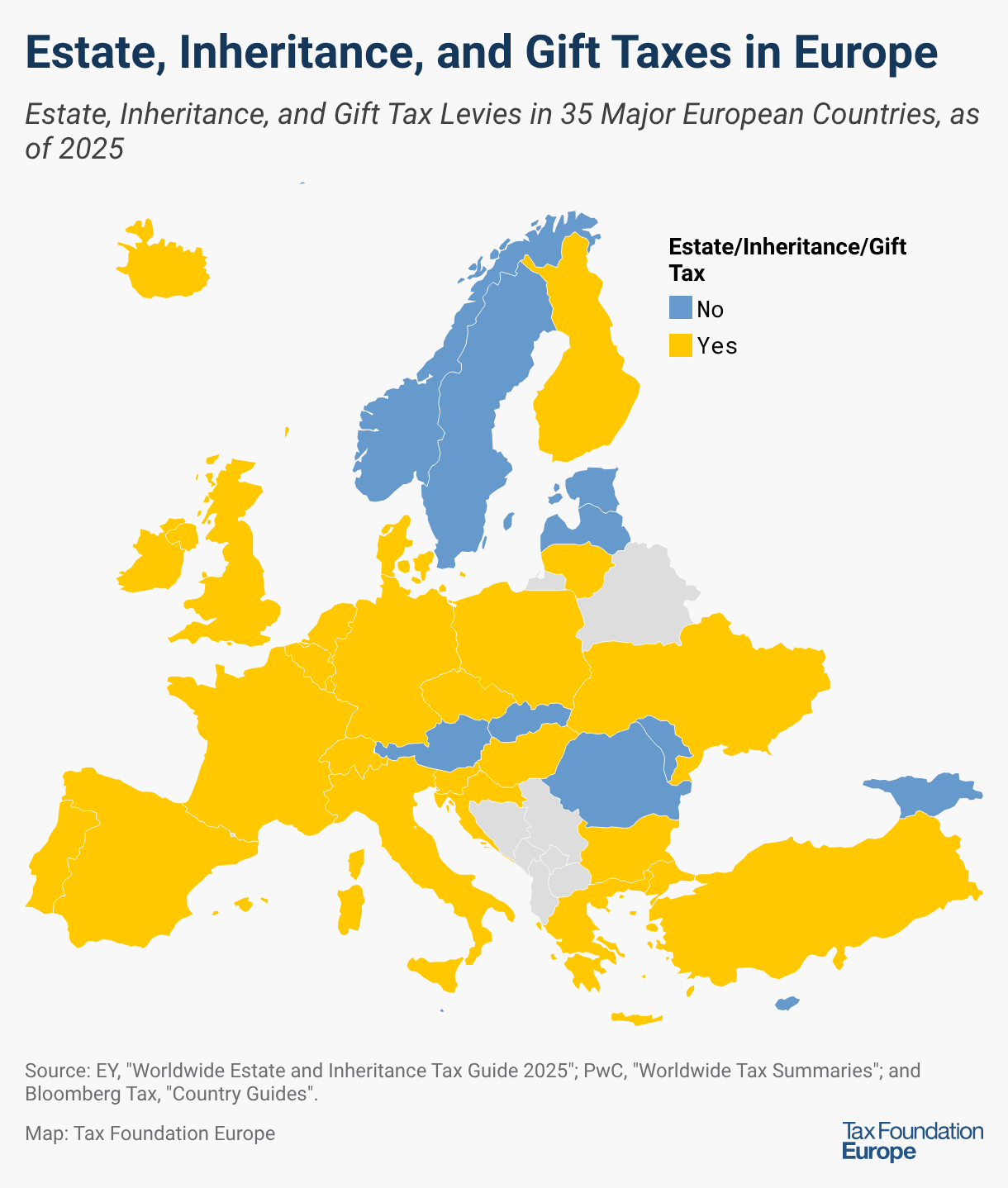
The Tax Foundation published its 2026 interactive map and analysis of estate, inheritance, and gift taxes across Europe, covering 35 countries in the European Union and European OECD member states. The report, authored by economist Cristina Enache, finds that 24 of those 35 countries currently levy some form of estate, inheritance, or gift tax. Rates vary dramatically across the continent, from Bulgaria's modest 0.4 to 6.6 percent to Spain's eye-catching range of 7.65 to 87.6 percent.
The report highlights several notable developments in European tax policy. Germany's Federal Constitutional Court is actively reviewing whether the country's inheritance tax rules unconstitutionally favor transfers of business assets over private assets, a case that could reshape how one of Europe's largest economies handles generational wealth transfer. Norway introduced a 37.84 percent exit tax on unrealized gains when shares transfer by gift or inheritance to recipients outside Norway. Denmark plans to abolish its additional 25 percent inheritance tax on transfers to siblings, effective 2027.
The Tax Foundation analysis also notes a key structural distinction between estate taxes and inheritance taxes. Estate taxes fall on the property of the deceased and the estate pays them before distribution. Inheritance taxes, by contrast, fall on the heirs themselves based on the value of assets they receive. Some families face both taxes when estates span multiple jurisdictions, a complexity that EU member states have attempted to address through double-taxation relief mechanisms. The report cites OECD guidance that frames these taxes as tools for reducing wealth inequality, while the Tax Foundation itself argues the taxes produce limited revenue and harm entrepreneurial activity, saving, and work incentives.
What It Means
For Georgia families, this global snapshot provides useful context for understanding how fortunate they are under current law. Georgia imposes no state estate tax and no state inheritance tax. That places Georgia firmly in a minority position even within the United States, where 12 states and the District of Columbia still levy their own estate taxes on top of the federal system. Compared to countries like France, where transfers between non-relatives face rates up to 60 percent, or Belgium, where rates can reach 80 percent, Georgia residents transferring wealth to heirs face no state-level death tax at all.
The federal estate tax does apply to very large estates. The current federal exemption stands at $15,000,00026 USC 2001(c), 2010; P.L. 119-21 §70106Verified Sep 15, 2026View source per individual, or $30,000,00026 USC 2001(c), 2010; P.L. 119-21 §70106Verified Sep 15, 2026View source for married couples using portability. Estates below those thresholds owe no federal estate tax regardless of how assets transfer. The federal top rate of 40%26 USC 2001(c)Verified Sep 15, 2026View source applies only to taxable estates above the exemption threshold. For the overwhelming majority of Georgia families, the federal estate tax presents no practical concern. The European comparison underscores this point: countries like the United Kingdom apply a 40 percent rate on estates above much lower thresholds, and many European nations offer no equivalent to the generous federal exemption Americans currently enjoy. Understanding the difference between these tax structures matters when families read international headlines about inheritance taxes and wonder how those rules translate to their own situation. The distinction between estate taxes and inheritance taxes affects who pays, when they pay, and how much planning is required.
Even without a state death tax, Georgia families still navigate meaningful estate planning considerations. Probate in Georgia typically runs 9 months to 12 months, with attorney fees generally falling between 2.1%O.C.G.A. § 53-7-6(4) (PR authorized "to provide competent legal counsel for the estate...either the personal representative or the attorney employed may, by petition to the probate court...obtain a judgment fixing the attorney's fees and expenses"; no statutory percentage) (Verified 2026-09-08 against GA Code § 53-7-6 (2025))Verified Sep 8, 2026View source and 3.4%O.C.G.A. § 53-7-6(4) (PR authorized "to provide competent legal counsel for the estate...either the personal representative or the attorney employed may, by petition to the probate court...obtain a judgment fixing the attorney's fees and expenses"; no statutory percentage) (Verified 2026-09-08 against GA Code § 53-7-6 (2025))Verified Sep 8, 2026View source of the estate's value. The court filing fee alone runs $175O.C.G.A. § 15-9-60(e)(1) (2024 Ga. L. Act 515 / SB 232, eff. 1/1/2025)Verified Sep 8, 2026View source, and creditors have 3 monthsO.C.G.A. § 53-7-41(d) ("within three months from the date of publication of the personal representative's last notice") (Verified 2026-09-08 against GA Code § 53-7-41 (2025))Verified Sep 8, 2026View source to file claims after the executor publishes notice. Georgia requires executors to post a surety bond, though heirs can waive this requirement by unanimous consent. These costs and delays exist entirely apart from tax exposure, meaning that even tax-advantaged Georgia estates benefit from thoughtful planning. Families who want to understand the full picture of what probate costs and involves can explore what probate actually entails and the reasons families choose to bypass it through trusts and other tools.
Context from SimplyTrust
The European tax data reinforces a point that applies equally to Georgia residents: the absence of a death tax does not eliminate the need for estate planning. Probate costs, family disputes, incapacity events, and the absence of clear instructions for asset distribution all create real burdens for families who delay planning. Georgia wills require 2O.C.G.A. § 53-4-20Verified Oct 18, 2026View source witnesses and a testator who has reached 14 yearsO.C.G.A. § 53-4-20Verified Oct 18, 2026View source of age. Notarization is not required for a Georgia will to be recognized. Georgia does not recognize handwritten wills, meaning informal handwritten documents carry significant risk. A financial power of attorney in Georgia requires notarization along with 1O.C.G.A. §§ 10-6B-1 through 10-6B-81Verified Sep 18, 2026View source witness, and Georgia allows springing powers of attorney that activate only upon incapacity. Families navigating these requirements can start with SimplyTrust's free Last Will and Testament builder or the free Financial Power of Attorney builder, both designed to meet Georgia's execution requirements.
For families whose estates may benefit from avoiding probate entirely, Georgia recognizes Transfer on Death Deeds, allowing real property to pass directly to named beneficiaries without court involvement. A revocable living trust accomplishes the same goal for a broader range of assets, and transferring assets into a Georgia revocable trust carries no transfer tax. Property tax reassessment does not trigger when real estate moves into a revocable trust in Georgia. Families interested in understanding how trusts interact with probate avoidance can explore how trusts help avoid probate and review the free Revocable Trust builder to understand what a complete trust document covers.
Source: Estate, Inheritance, and Gift Taxes in Europe, 2026 | Tax Foundation